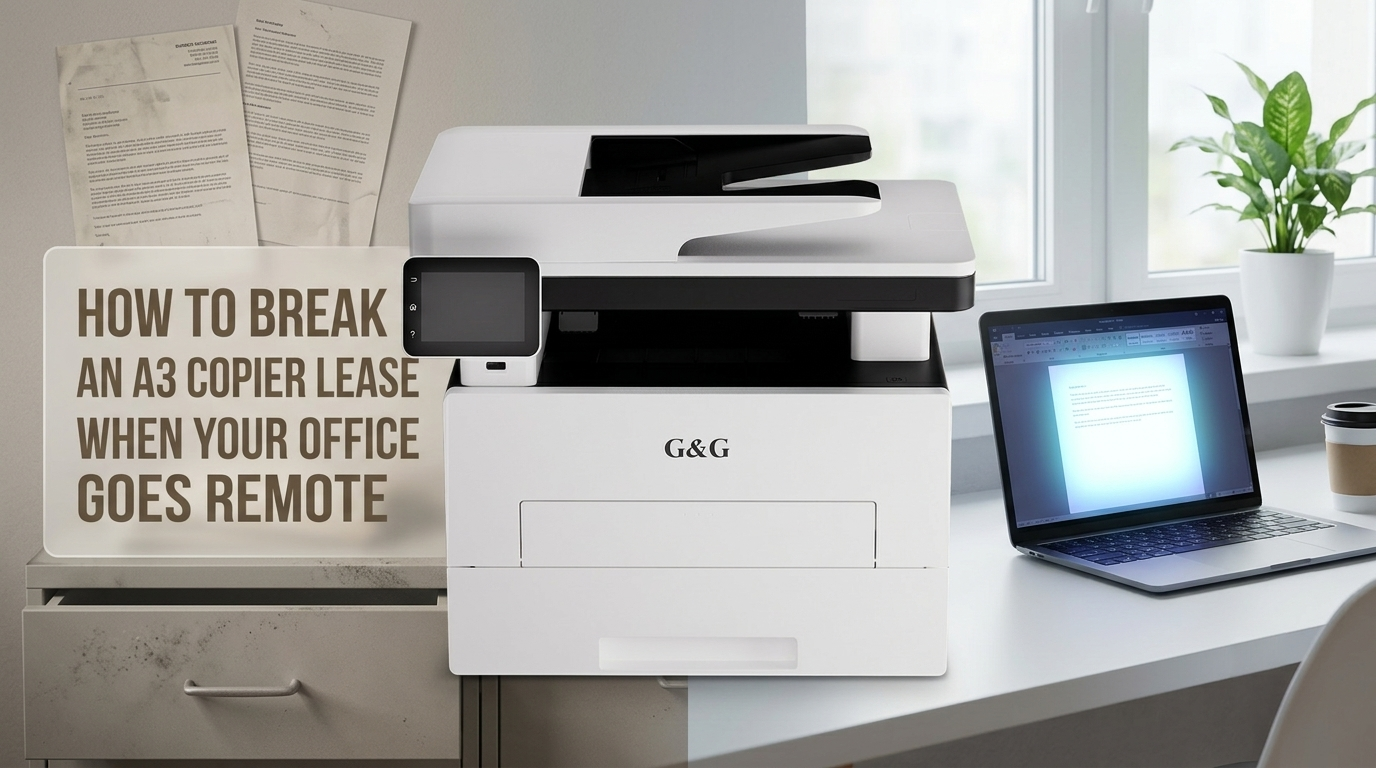
If you walk into your physical workspace right now, office copier is likely sitting in a dark, quiet corner. The game has moved to laptops, cloud sharing, and digital signatures. Yet, while your employees are working comfortably from home, that giant piece of metal is still draining your bank account every single month.
Can you get out of a commercial copier lease without paying massive, business-crushing penalties?
Yes, but you cannot simply stop paying or walk away.
To break a lease without destroying your credit or getting hit with a lawsuit, you generally have four real options:
1. Negotiating an early buyout (often at a discount if you know how to ask).
2. Setting up a structured settlement with the copier lease company.
3. Finding another local business to take over the contract (a lease assumption).
4. Trading down the massive machine for small, remote-friendly setups.
Getting out cleanly depends entirely on the specific math hidden inside your contract, and we are going to show you exactly how to decode it.
The Reality of A3 Copier Market: Why Do We Have This Thing?
It makes zero financial sense to pay a premium copier lease cost for a machine that prints maybe 200 pages a month. In the past, running 8,000 pages a month was normal. Today, spending thousands of dollars on a massive a3 copier just to let it collect dust is a massive operational leak.
Even the Giants are Shifting Focus
You aren't the only one realizing the world has changed; the multi-billion-dollar printing manufacturers know it too. The industry giants aren't even leading their sales pitches with copiers anymore. Ricoh brands itself around digital workplace services. Xerox focuses on software automation.
Even more shocking, HP—the iconic pioneer of office printing—announced the closure of its historic LaserJet operation hub in Boise, Idaho, by 2027. When the very birthplace of the office printer shuts its doors, it’s a massive wake-up call. The a3 copier market share is shrinking because the business world is moving away from physical paper infrastructure.
The True Price of Sitting Idle
When you originally signed your contract, the sales focused on the monthly payment, not the true total a3 copier price. But when you add up the base lease, the mandatory service contract, and the cost of parts, copier leasing becomes an incredibly expensive anchor for a decentralized team.
Every dollar you spend on a copier that your remote team cannot even access is a dollar taken away from software tools, cybersecurity, and digital upgrades that actually help your business grow right now.
What Copy Lease Agreement Do You Have?
Locating and Reading Your Contract
Dig up the original copy of lease agreement you signed. Do not rely on what the salesperson told you over the phone years ago; you need to audit the literal fine print on the back of the page. This contract is the rulebook that the leasing company will use, so you need to understand it just as well as they do.
FMV (Fair Market Value) Leases vs. $1 Buyout Leases
The type of lease you signed completely changes your financial strategy and your buyout math.
FMV (Fair Market Value) Lease: This is the most common type. It keeps your monthly payment lower because you are essentially renting the a3 printer copier. At the end of the term, you don't own it. If you want to break this early, the leasing company will usually demand all remaining payments plus what they estimate the machine is worth at that time.
$1 Buyout Lease: This acts more like a traditional equipment loan. Your monthly payments are higher, but once the lease ends, you own the machine for a single dollar. If you break this early, you generally only owe the remaining balance of the equipment's core cost, without additional hidden "end-of-lease" return fees.
Automatic Rolling Renewal
Almost every contract from a major leasing entity contains a "Letter of Intent" clause. It states that if you do not notify them in writing—usually exactly 60 to 90 days before the lease expires—the contract will automatically renew for another 12 months.
Your 4 Legal and Financial Options to Break the Lease
Option 1: The Early Buyout and Equipment Purchase
Does breaking a lease mean you have to pay all remaining payments right now in one lump sum? Usually, yes—but there is a loophole. You can request an "Early Buyout Quote to Purchase."
Instead of just paying out the lease and returning the machine, you pay a single lump sum to buy the a3 copier printer outright. Because you are buying the hardware completely, the leasing company will sometimes waive the remaining interest or administrative fees. Once you own it, you can instantly cancel the expensive monthly maintenance contract and sell the physical machine on the used market to recoup your cash.
Option 2: Negotiating a Restructured Settlement
Leasing companies prefer getting some money over getting nothing or chasing a bankrupt business through court. If your physical office is closing permanently, approach the provider with absolute honesty.
Show them your corporate restructuring plan or your lease termination notice. Offer a lump-sum settlement—for example, 60% to 75% of the remaining total balance—to terminate the contract immediately. Get everything in writing, ensuring that once the settlement is paid, you are released from all future liability and the vendor handles the pickup of the printer.
Option 3: Lease Assumption and Transfers
If you cannot afford a lump-sum payout, look into a lease assumption. This is identical to transferring a car lease to a new owner.
Search for local businesses, schools, or medical clinics in your area that are actually expanding their physical offices. If they are in the market for a heavy-duty a3 printer scanner copier, you can transfer your existing contract directly into their corporate name. The leasing company will charge a minor transfer fee, but your business walks away completely free of the monthly liability.
Option 4: Downgrading and Upgrading Simultaneously
This is the ultimate win-win scenario. Contact your vendor and explain that your team has transitioned to a fully remote office. Tell them you no longer need a massive commercial unit, but you do need smaller laser printer for your homes.
Many vendors will gladly tear up your current contract if you agree to pivot your business into a fleet of decentralized, compact home-office printers. They keep you as a client, and you get rightsizing devices that your remote staff can actually use.
The true future of small business operations isn't about what happens on the paper; it is about what happens around the document. Cloud collaboration tools, automated PDF routing, and secure digital signatures mean your documents are created, edited, approved, and archived without ever touching ink. The market has shifted, workflows have evolved, and your overhead needs to match your new remote reality.
By taking charge of your contracts, you can stop paying for a past way of working and fund the future of your remote team.