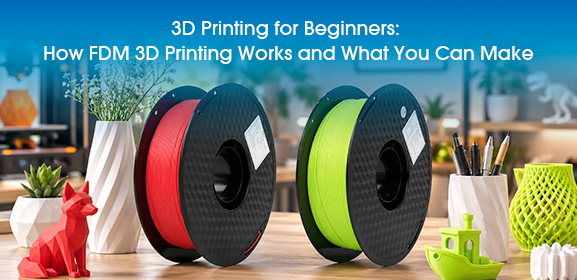
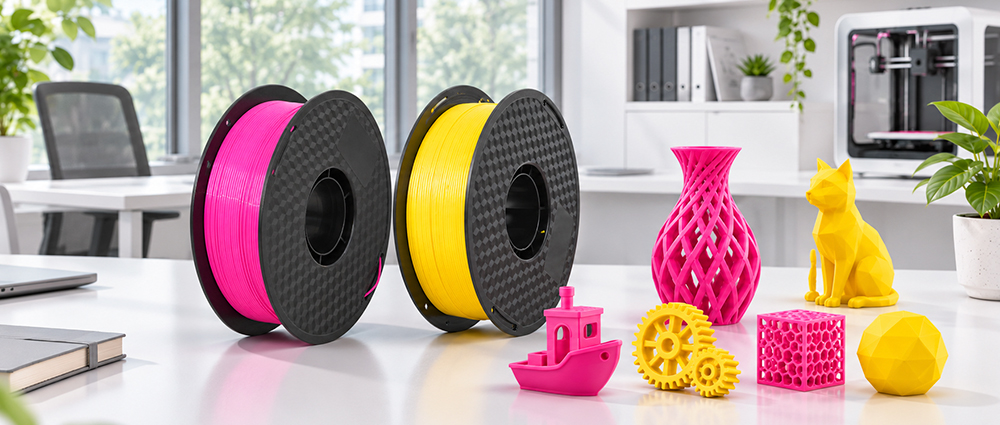
Choosing between PLA and PETG is one of the first decisions every 3D printing beginner faces. Both are popular 3D printer filaments for FDM (Fused Deposition Modeling) machines, and both come on 1.75mm spools, but they behave very differently.
This PLA vs PETG guide explains the differences in plain language so you can pick the best filament for your project.
Quick Answer: PLA or PETG?
Choose PLA if you want an easy-to-print filament with a great surface finish, vivid colors and fine detail. It is ideal for beginners, toys, decor, figurines and display models.
Choose PETG if you need a tougher, more durable part that handles moisture, sunlight and everyday wear better. It suits functional parts, containers and outdoor items.
Rule of thumb: PLA is the easy, good-looking choice. PETG is the tougher, more practical choice.
What Is PLA Filament?
PLA (polylactic acid) is the most widely used FDM filament in the world. It is made from plant-based raw materials such as corn starch or sugarcane, and it prints at relatively low temperatures with very little shrinkage. That makes it forgiving for beginners and reliable on most mainstream printers.
Advantages of PLA filament:
Easy to print, with low warping
Sharp detail and a clean surface finish
Huge range of colors and finishes, including silk and matte
Usually the most budget-friendly option
Limitations:
More brittle than PETG, so it can snap under impact
Softens at lower temperatures, so it is not ideal for hot cars or direct sun
Less resistant to long-term outdoor exposure
What Is PETG Filament?
PETG (polyethylene terephthalate glycol) is a modified version of the plastic used in water bottles. The added glycol makes it clearer, tougher and easier to print than standard PET. Many people think of it as a middle ground between the easy printing of PLA and the toughness of ABS.
Advantages of PETG filament:
Tougher and more impact-resistant than PLA
Good layer adhesion, which makes parts feel strong
Better resistance to water and moisture
Better heat and weather resistance than PLA
Limitations:
Needs a hotter bed and nozzle than PLA (typically 230-250°C nozzle)
More prone to stringing (thin wisps of plastic between parts of a print)
Absorbs moisture from the air, so it benefits from careful storage and drying
PLA vs PETG Comparison Table
Feature | PLA | PETG |
Ease of printing | Very easy | Easy, but needs more tuning |
Surface finish | Excellent, sharp detail | Smooth, slightly glossy |
Strength type | Stiff and rigid, can be brittle | Tougher, more flexible |
Impact resistance | Lower | Higher |
Heat resistance | Lower (softens around 55-60°C) | Higher (holds to about 75-80°C) |
Water and moisture resistance | Fair | Good |
UV and outdoor use | Limited | Better suited |
Stringing | Less common | More common |
Support removal | Easy | Harder (PETG bonds strongly) |
Bed temperature (G&G specs) | 50-65°C | 65-80°C |
Nozzle temperature (typical) | 190-220°C | 230-250°C |
Print speed | Faster | Slower, best at moderate speeds |
Cost per kg | Usually the lowest | Usually slightly higher |
Best for | Models, toys, decor, prototypes | Functional parts, outdoor items |
Is PETG Stronger Than PLA?
It depends on what "strong" means. In raw stiffness, PLA is very rigid, and G&G's PLA Basic is specified at 56-59 MPa tensile strength compared with 50-55 MPa for G&G PETG. (MPa, or megapascals, is a unit of strength: higher numbers mean the material resists more pulling force before breaking.)
In real-world use, though, PETG usually feels stronger because it is less brittle. It can flex and absorb impacts instead of cracking, and its layers bond well. So PLA is stiff and rigid, while PETG is tougher and more durable.
Which Is Easier to Print: PLA or PETG?
PLA is easier. It prints at lower temperatures, sticks well to the bed, and rarely strings or warps. For anyone asking "what is the best filament for beginners?” PLA is the standard answer.
PETG is still beginner-friendly, but expect to fine-tune your settings:
Bed temperature: PETG prefers a hotter bed (65-80°C versus 50-65°C for PLA).
Nozzle temperature: PETG typically prints at 230-250°C, compared with 190-220°C for PLA. Always follow the range printed on your spool.
Stringing: Lower the temperature slightly, adjust retraction, and keep the filament dry.
Print speed: PLA can usually run faster. PETG prints best at moderate speeds, so expect slightly longer print times.
Which Is Better for Outdoor Use?
For items that live outside, such as garden planters, signs and brackets, PETG is the better choice. It handles moisture, sunlight (UV, or ultraviolet light) and temperature changes better than standard PLA. PLA typically starts to soften at around 55-60°C, which a car dashboard or a sunny windowsill can reach, while PETG holds its shape up to roughly 75-80°C.
If you only need a decorative piece for indoor display, PLA is perfectly fine.
PLA vs PETG Cost: Which Is Cheaper?
PLA is usually the cheaper filament per kilogram, and it is the easiest to find in a wide range of colors. PETG typically costs a little more, but the gap is small.
The real cost of a print also includes failed attempts. Because PLA is more forgiving, beginners usually waste less material with it. Once your settings are dialed in, PETG is good value for functional parts that need to last.
PLA Types: Basic, Silk and Matte
Not all PLA looks the same. These three finishes are popular for different projects:
PLA Basic: A smooth, reliable all-rounder for everyday printing, toys and prototypes.
Silk PLA: A high-gloss, satin-like finish with a metallic sheen, great for vases, trophies and decorative figurines.
Matte PLA: A soft, non-reflective surface that shows fine detail and hides layer lines, great for detailed models, education and mock-ups.
Filament | Finish | Tensile strength | Elongation at break | Best for |
PLA Basic | Smooth | 56-59 MPa | 6-8% | Everyday prints, prototypes |
PLA Silk | Glossy, metallic | 45-46 MPa | 10-15% | Display pieces, decor |
PLA Matte | Soft, fine texture | 45-46 MPa | 6-8% | Detailed models, education |
PETG | Smooth | 50-55 MPa | 6-10% | Durable, outdoor-use items |
Figures are from G&G's published specifications for 1.75mm filament. Elongation at break shows how far a material can stretch before snapping.
How to Choose the Best 3D Printer Filament
Ask yourself these four questions:
Where will the print be used? Indoors and for display points to PLA. Outdoors or in a warm place points to PETG.
Does it need to take impact or wear? If yes, choose PETG.
How important is the look? For gloss, pick Silk PLA. For a refined, low-glare finish, pick Matte PLA.
How experienced are you? New to FDM printing? Start with PLA.
What Makes Filament Quality Different?
Two spools of the same material can print very differently. Three things matter most:
Diameter consistency. A 1.75mm filament should stay close to 1.75mm along the whole spool. Tight tolerance (G&G specifies ±0.02mm) helps the printer feed a steady flow and reduces under-extrusion (not enough plastic coming out of the nozzle).
Moisture. Filament absorbs water from the air. Damp spools cause bubbles, stringing and weak prints, so store them sealed with desiccant and dry them at the manufacturer's recommended temperature when needed.
Batch consistency. Reliable color and performance from spool to spool means you can reprint a project months later and get the same result.
Frequently Asked Questions
Is PLA or PETG better for beginners?
PLA. It prints at lower temperatures, sticks well to the bed and is less likely to string, which makes it the easiest way to start 3D printing.
Is PETG stronger than PLA?
PETG is generally tougher and more impact-resistant, while PLA is stiffer but more brittle. For parts that may be dropped, bent or used outdoors, PETG is usually the better pick.
Can I use PLA and PETG on the same printer?
Yes, most FDM printers handle both. You will need to adjust nozzle and bed temperatures when you switch materials.
Is PETG better than PLA for outdoor use?
Generally yes. PETG resists moisture and UV better and holds up to heat longer, while standard PLA can soften in sun and heat.
Which filament is better for detailed models and figurines?
PLA, especially Matte PLA for fine detail and Silk PLA for a glossy, eye-catching finish.
Why does my PETG print have strings?
The most common causes are damp filament and a nozzle temperature that is too high. Dry the spool and lower the temperature in small steps, then adjust retraction.
What diameter filament should I buy?
Most desktop FDM printers use 1.75mm filament. Check your printer's manual to confirm.
Is PLA or PETG food safe?
Some PLA and PETG grades are made from food-contact-approved resin, but a printed part is a different matter. Layer lines can trap bacteria and some nozzles contain lead, so do not assume any 3D print is food safe. For anything that touches food, use a certified food-contact filament, a stainless-steel nozzle and a food-safe coating.
Is PLA biodegradable?
PLA is made from plant-based materials and is compostable in industrial composting facilities. It does not break down quickly in a home compost bin or in the ground. PETG is not biodegradable.
What temperature should I print PLA and PETG at?
As a starting point, print PLA at 190-220°C with a 50-65°C bed, and PETG at 230-250°C with a 65-80°C bed. The exact range for each spool is printed on its label.