It all depends on how much you print.
If you print more than 15–20 pages a week, an ink tank printer is almost always the better investment because it pays for itself in ink savings within about 12 to 18 months. However, if you only print a return label once a month, a traditional inkjet printer cartridge system is actually better because the printer itself costs much less upfront. It’s all about finding your trade-off—the moment those ink savings finally overtake the higher price of the printer.
Inkjet Printing
How an Inkjet Printer Works
Think of inkjet printing like a highly advanced version of a painter’s airbrush. Inside your inkjet printer, there is a print head that moves back and forth, spraying thousands of tiny, microscopic drops of liquid ink onto the paper to create your images and text. It’s precise, fast, and produces beautiful colors, which is why a color inkjet printer is the go-to choice for photos and school projects.
The Traditional Cartridge for Inkjet Printer
For years, the cartridge for inkjet printer was the only way to go. These are small, plastic rectangular boxes filled with ink. When the ink runs out, you pull the whole box out and snap a new one in. It’s clean and very easy to do, but because the cartridges are small, you have to replace them more often. This is where most of the cost of inkjet printer printing comes from over time.
The Evolution of the Ink Tank Printer
Instead of small cartridges, these printers have large, built-in reservoirs (tanks) on the side or front. When you run low, you don’t throw a plastic shell away; you simply grab a bottle of ink and pour it directly into the tank. It’s like filling up your car with gas instead of replacing the entire engine every time the tank is empty! This system allows for inkjet printing of thousands of pages before you ever need to buy more ink.
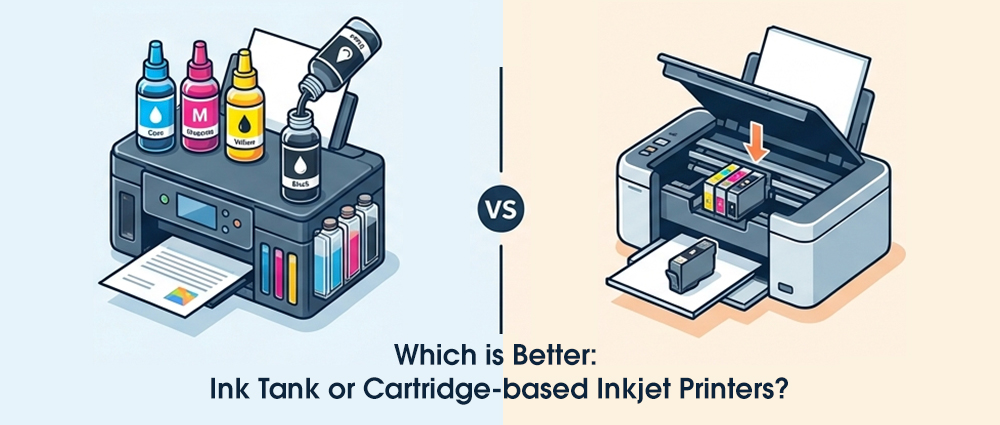
Difference Between Inkjet and Ink Tank
Upfront Costs vs. Long-term Value
When you walk into a store, the color inkjet printer that uses cartridges will look like a bargain. You can often find a great one for under $100. On the other hand, an ink tank printer might cost $250 to $400 upfront.
It feels like a lot, but here is the secret: the cartridge printer is cheap because the manufacturer expects you to buy ink for years. The ink tank printer is more expensive because it comes with enough ink in the box to last most people two whole years.
The Maintenance Factor
Every inkjet printer needs to stay "wet." If you don’t print for months, the ink in the nozzles can dry up. If you only print once a month, a inkjet cartridge is actually safer because if it clogs, you can just replace the cartridge (which has a fresh print head). With an ink tank, you need to print at least a page or two every week to keep the lines flowing smoothly.
Space and Design
Most cartridge printers are sleek and compact, perfect for a dorm room desk. However, if you are a designer or a researcher needing a wide format inkjet printer to print large charts or posters, you’ll find that ink tanks are becoming the new standard. They are built a bit tougher to handle the heavy lifting of inkjet printer printing all day long.
Why Quality Matters: The G&G Advantage
Whether you choose a cartridge or a tank, the ink you put inside matters. Using a high-quality G&G inkjet cartridge ensures that your inkjet printer doesn't just work—it thrives.
G&G ink is formulated to provide professional-grade, vibrant results. Whether you are doing a simple inkjet print for a school project or using a wide format inkjet printer for a business presentation, you get the same deep blacks and bright colors every single time.
Choosing between these
two isn't about which technology is "better"—it's about which one fits
your budget and your habits. If you print in bulk, the ink tank is a
champion that pays for itself. If you print only when necessary, the
traditional inkjet printer is a reliable partner that won't break the
bank upfront.