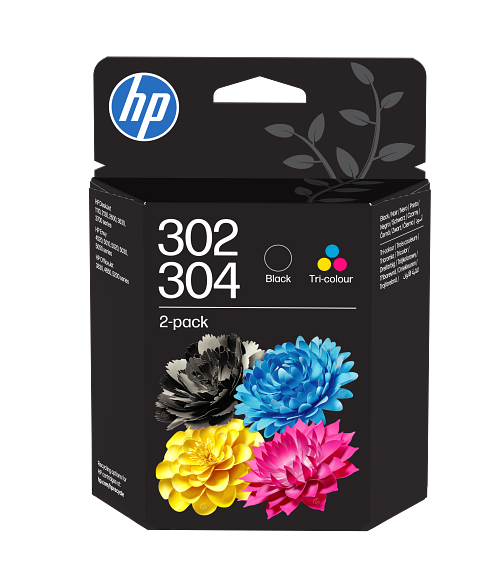
 HP has recently introduced a new ink cartridge series: HP 302/304. At first glance, it may look like a simple packaging update, or just two cartridge numbers printed on the same box. But in the wider context of the inkjet consumables market, this change is more meaningful than it first appears.
The launch of HP 302/304 is not a typical technology upgrade. Instead, it reflects a broader adjustment in how Original HP ink cartridges are structured, managed, and sold. In a mature inkjet market, this is less about creating a new-generation cartridge and more about simplifying historical SKUs, improving channel efficiency, and making the buying process easier for users.
What Is HP 302/304 Ink Cartridge?
Simply put, HP 302/304 is a unified ink cartridge series designed to replace the previous HP 302 and HP 304 cartridge ranges.
In the past, users had to check whether their printer used HP 302 or HP 304 before buying a replacement cartridge. With HP 302/304, these two choices are brought into one clearer replacement path.
For end users, the benefit is straightforward: it becomes easier to buy the right cartridge. For resellers and retailers, the benefit is operational: fewer similar SKUs to stock, display, and explain.
HP 302 vs HP 304: What Was the Difference?
To understand why HP 302/304 matters, it helps to look at the product background of HP 302 and HP 304.
HP 302 was mainly used in an earlier generation of entry-level HP inkjet printers and all-in-one devices, including basic models across the DeskJet, ENVY, and OfficeJet families. These printers were aimed at home users, students, and light office users. Typical print jobs included everyday documents, homework, forms, simple graphics, and occasional colour printing.
This product segment reflects a long-standing model in the inkjet market: printers are sold at a relatively low entry price, while ink cartridges generate recurring revenue over the life of the device.
HP 304 can be seen as a later extension of the same entry-level inkjet ecosystem. It also served home and SOHO users, but was more closely linked with newer printer models that placed greater emphasis on wireless printing, mobile app use, and lightweight everyday printing. In terms of market distribution, HP 304 was more common in Europe.
From an industry perspective, the difference between HP 302 and HP 304 was not mainly about print technology. Their target users, print scenarios, and output needs were highly similar. The real difference was more about market positioning, regional strategy, channel management, and SKU planning.
Can HP 302 and HP 304 Be Used Interchangeably?
This is one of the most common questions from users. If the two cartridge families were so similar, why could they not simply be used in the same printers?
In the past, printers were usually designed to recognise a specific cartridge number through cartridge identification and chip recognition. This model also supported regional pricing, channel separation, and cross-market supply control.
So, the fact that HP 302 and HP 304 could not be mixed was not only a technical matter. It was also part of a broader consumables business structure.
Why Did HP Combine 302 and 304?
From a strategic point of view, HP 302/304 is a typical example of product line consolidation in a mature market.
For a cartridge system that has existed for many years, keeping multiple similar SKUs may bring less value over time, while increasing management cost. For users, having both HP 302 and HP 304 in the market added extra checking and decision-making. For retailers and resellers, two similar cartridge families meant duplicated listings, duplicated stock, and more customer explanation.
For HP, reducing similar SKUs can help improve supply chain efficiency and simplify operations in a market driven mainly by replacement demand.
In other words, the key point of HP 302/304 is not that HP has created a more powerful cartridge. The key point is that HP is using fewer product numbers to serve the same group of printing needs.
Is HP 302/304 Cheaper to Use? A Look at Cost per Page
The HP 302/304 change simplifies the buying process, but it does not necessarily reduce the cost of printing.
Based on current market prices and page yield data, the cost per page of HP 302/304 appears to remain broadly close to the previous HP 302 and HP 304 ranges, with differences depending on the specific cartridge type. In some cases, HP 302/304 does not show a clear cost advantage; for certain XL cartridges, the previous HP 302 range may even offer a relatively lower cost per page.
This shows that HP 302/304 mainly improves the buying path, SKU structure, and channel efficiency. It does not fundamentally change the cost model of Original HP ink cartridges.
For users, the main value is reduced confusion. For the channel, the main value is lower SKU complexity. But for long-term printing costs, users still need to compare original cartridges with alternative solutions in a practical way.
What HP 302/304 Means for Users, Resellers, and the Inkjet Market
HP 302/304 reflects a wider trend in the inkjet consumables industry: as product categories mature, competition shifts from model complexity to structural efficiency and value efficiency.
Once the model choice becomes simpler, users are no longer stuck asking, “Should I buy 302 or 304?” Instead, they are more likely to ask, “Which option gives me better cost per page, stable supply, reliable performance, and better long-term value?”
This also gives compatible and remanufactured cartridges a clearer market position. When the original cartridge system becomes more unified, alternative solutions can focus more directly on value, efficiency, and sustainability.
G&G HP 302/304 Remanufactured Cartridges: Higher Yield, Lower Cost per Page
In response to this market change, G&G has also moved quickly with a remanufactured ink cartridge solution for the HP 302/304 system.
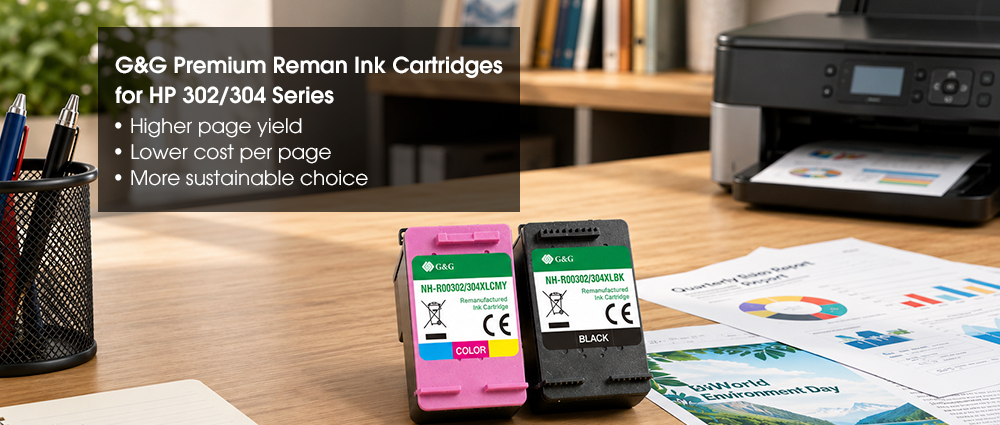
Designed to support the ongoing printing needs of home users, students, small offices, and frequent everyday printing users, while helping reduce the need for frequent cartridge replacement.
Compared with Original HP printhead ink cartridges, G&G remanufactured HP 302/304 cartridges help users reduce long-term printing costs and make everyday printing more economical.
Following the HP 302/304 unified trend, G&G helps reduce confusion between 302 and 304, while also making product recommendation, listing, and inventory management easier for channels.
By collecting used empty cartridges and remanufacturing them, G&G helps improve resource reuse and reduce single-use cartridge waste.
OEM Model | G&G Model | Page Yield | Area | For Use In |
OEM | G&G |
HP 302/304 | NH-R302/304XLCMY | 300 | 450 | Europe | HP DeskJet 1110/2130/2600/3630/3700 series; Envy 4520/5010/5020/5030/5050 series; OfficeJet 3830/4650/5200 series. |
HP 302/304 | NH-R302/304XLBK | 300 | 600 |
HP 63/65 | NH-R63/65XLCMY | 300 | 450 | Canada | HP DeskJet 3755; DeskJet 3755; OfficeJet 3830. |
HP 63/65 | NH-R63/65XLBK | 300 | 600 |
Conclusion: Simpler Cartridge Choices, Clearer Value Comparisons
HP 302/304 is not a major technology leap. It is a structural consolidation of a mature inkjet cartridge system.
It helps users buy the right cartridge more easily and helps channels operate with less complexity. However, it does not fundamentally change the cost structure of Original HP ink cartridges.
As cartridge model complexity decreases, market competition will increasingly return to the issues that matter most: cost per page, supply stability, environmental value, and long-term printing efficiency.
For users, the future question may no longer be only, “Will this cartridge work with my printer?” It will also be: “Is it more cost-effective, more sustainable, and better suited for long-term use?”